The problem
AegisShield wanted to test a new web application security product without putting a real customer or live booking flow at risk.
Junior Technical Project Manager · Fictional product case
A new web application firewall product for AegisShield, taken from the first idea through product definition, safe testing and a controlled pilot decision.
The problem
AegisShield wanted to test a new web application security product without putting a real customer or live booking flow at risk.
My role
I turned the idea into a clear pilot, organized the work, connected risks to tests, and kept the decision points visible.
How I worked
Hybrid: a simple plan for scope, approvals, risks, and dates, with short build-and-test loops for the product work.
What happened
A simulated false positive was found, corrected, and retested. The pilot was accepted; production stayed outside the approved release.
Project timeline and documents
Follow the AegisShield Web Application Firewall case from product definition and validation into launch execution. The Launch phase puts the approved marketing strategy into motion across five channels.
Phase 1
The sponsor frames the customer problem and asks the PM to coordinate discovery for a new web application firewall product.
DetailsThe PM turns the initial request into a testable product opportunity and an investment decision framework.
DetailsThe team records simulated findings and recommends a limited product-definition and technical-validation stage.
DetailsThe PM turns the discovery recommendation into a small, testable product stage.
DetailsThe CTO authorizes the product-definition and technical-validation stage and sets its limits.
DetailsThe PM identifies who must shape, review, approve and receive updates about the AegisShield Firewall product stage.
DetailsThe team confirms the authorized product stage, working agreements, first planning actions and the gate into Planning.
DetailsPhase 2
The team converts the approved product boundary into requirements and acceptance criteria for the first AegisShield Firewall version.
DetailsDesign defines the administrator journey for setup, event review, rule management and safe exceptions.
DetailsEngineering and Security compare technical paths and define a safe delivery sequence.
DetailsThe approved product-definition work is organized into deliverables and work packages.
DetailsThe team agrees who is responsible, accountable, consulted and informed for each product deliverable.
DetailsThe work packages become prioritized product and technical backlog items with estimates and dependencies.
DetailsThe PM makes the simulated capacity, licensing and operating-cost assumptions visible before pilot-build authorization.
DetailsThe PM maps the planning activities, dependencies and decision gates for the AegisShield Firewall.
DetailsQA, Security and Operations define how the AegisShield Firewall will be tested without risking a legitimate booking flow.
DetailsThe team records the risks specific to launching a new application-protection product.
DetailsSecurity and Operations define the controls required before the AegisShield Firewall can be evaluated with BookEasy.
DetailsPhase 3
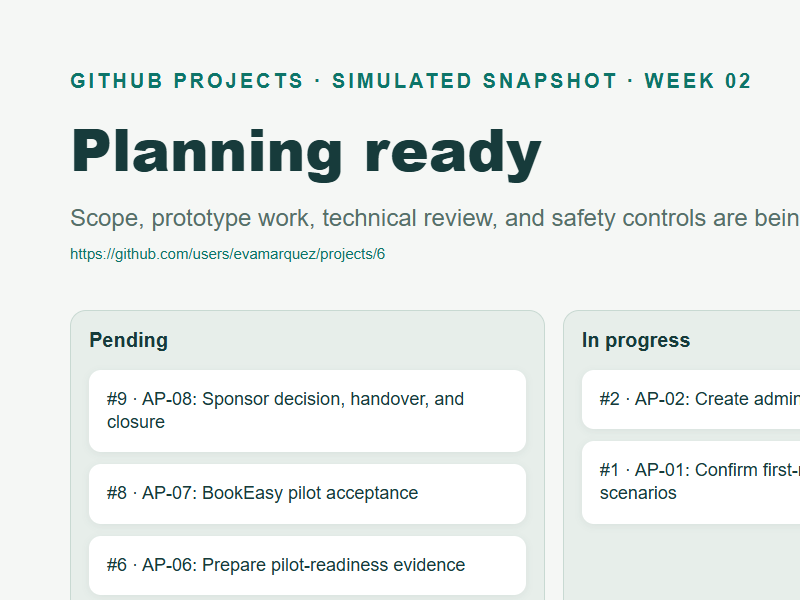
The PM uses a visible execution board to track product-definition work, owners, dependencies and evidence.
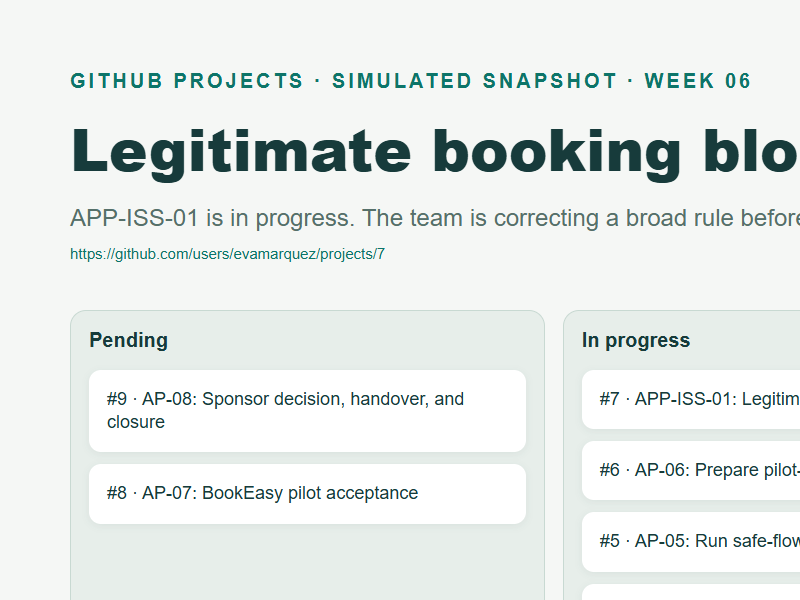
DetailsThe team records a false-positive issue that blocks a legitimate booking in controlled testing.
DetailsThe PM records the decision to correct the rule and protect the pilot boundary instead of reducing safety evidence.
DetailsThe PM reports the execution status, the safety issue, the recovery plan and the next sponsor gate.
DetailsPhase 4
QA records the safety, access, rule, exception, monitoring and recovery results before pilot acceptance.
DetailsBookEasy reviews the agreed application-protection scenarios and records acceptance of the limited pilot scope.
DetailsThe sponsor reviews the evidence and records whether the AegisShield Firewall may proceed to the approved controlled release stage.
DetailsThe team monitors the controlled release and transfers support, monitoring, recovery and rule-ownership responsibilities to Operations.
DetailsThe PM closes the AegisShield Firewall product-definition and pilot project and records outcomes, limitations and improvements for future work.
DetailsPhase 5
The sponsor hands the validated AegisShield Web Application Firewall to the cross-functional launch team and confirms that the product is ready to enter launch planning.
DetailsThe project story
The case shows the work behind a new product: what problem it solves, what belongs in the first release, how the team tests it, and what the sponsor needs to decide before a real launch.
Weeks 1–2
Compared build, buy, and integrate options. Defined the first release and the pilot boundary.
Weeks 3–4
Created the requirements, administrator journey, prototype, backlog, budget, and delivery plan.
Weeks 5–6
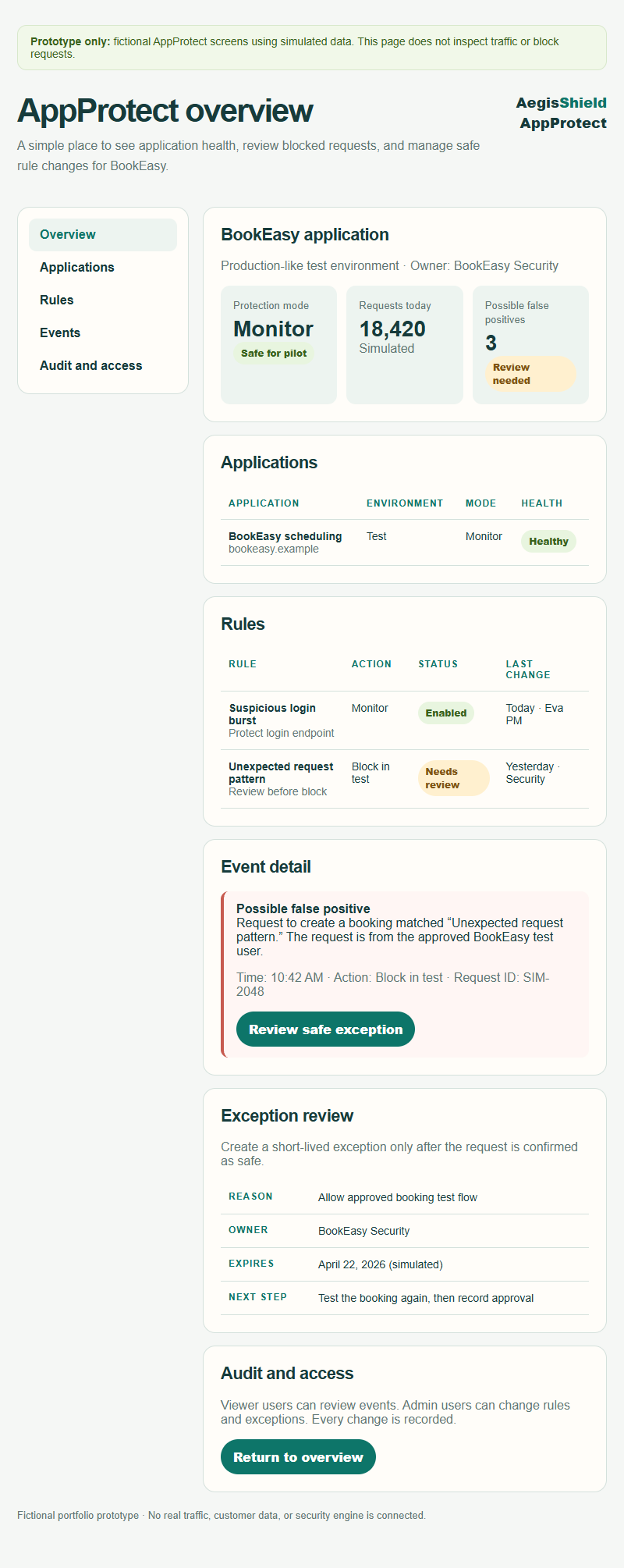
Ran safe-flow and blocked-request tests. Found a legitimate booking blocked by a broad rule.
Weeks 7–8
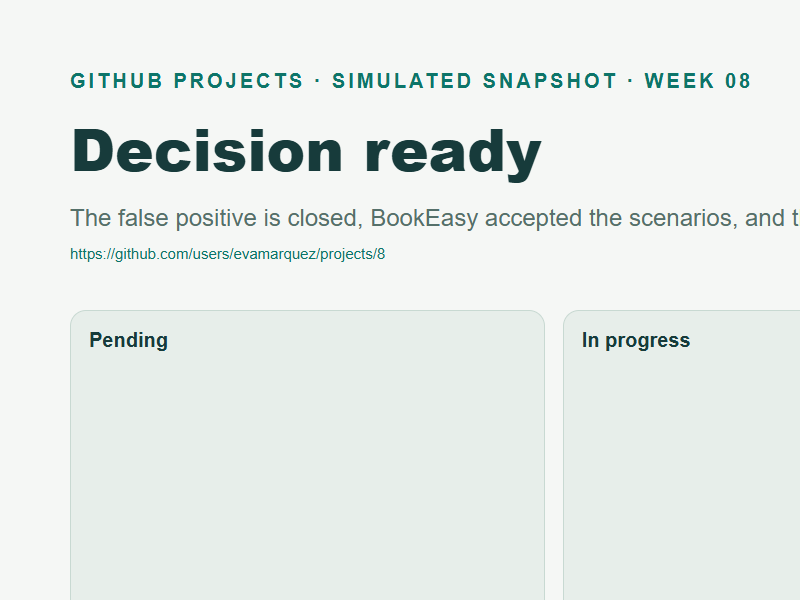
Narrowed the rule, added a controlled exception, retested the flow, and prepared the sponsor decision.
What changed during execution
The test found a false positive caused by a rule that was too broad. I connected the issue to the requirement, made the correction visible, kept the pilot controlled, and required a retest before moving forward. That gave the sponsor evidence for a pilot decision instead of a guess.
Evidence
The boards are public simulated snapshots. They show how the work looked before the issue, during the issue, and after the decision.
What is included
Discovery, business case, scope, requirements, and prototype.
Charter, WBS, RACI, backlog, budget, schedule, and technical plan.
Tests, risks, data protection, issue log, and decision records.
Pilot acceptance, release decision, handover, closure, and lessons learned.
AegisShield and BookEasy are fictional. This case is meant to show how I organize a technical product initiative, make assumptions visible, and use evidence to support decisions. It does not represent a real customer engagement or a live security service.